
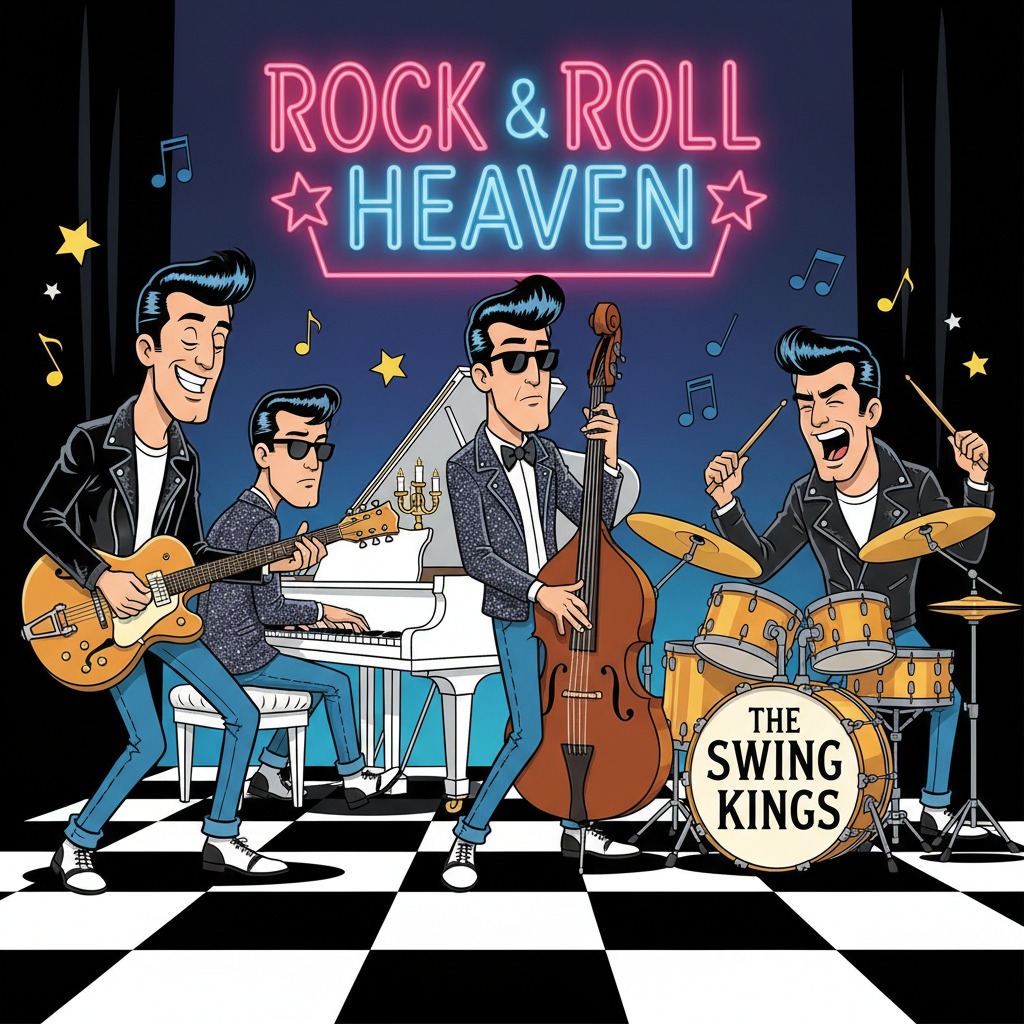
The Echo of the Upright Bass: The Resilience of Rockabilly
Rockabilly is more than just a musical genre; it is a high-octane collision of culture, rebellion, and raw rhythm. Emerging in the mid-1950s, it represents one of the earliest forms of rock and roll, blending the “rocking” intensity of African American rhythm and blues with the “hillbilly” twang of country music. It is a sound defined by the “slap” of an upright bass, the frantic picking of a hollow-body guitar, and a vocal style that jumps between soulful crooning and hiccups of pure adrenaline.
The Genesis: Memphis and the Sun Sound
The epicenter of the rockabilly explosion was Sun Studio in Memphis, Tennessee. Under the guidance of Sam Phillips, artists like Elvis Presley, Carl Perkins, and Jerry Lee Lewis stripped away the polished production of the era to find something primal.
The DNA of rockabilly is distinct. Unlike the heavy, distorted rock that would follow decades later, rockabilly relied on “slapback echo”—a production technique that gave vocals and guitars a haunting, rhythmic stutter. The percussion was often minimal, sometimes consisting of nothing more than a snare drum or the rhythmic clicking of the bass strings against the fingerboard. It was music made by young people who were impatient, loud, and desperate to dance. However, by the early 1960s, the initial flame had flickered out, superseded by the British Invasion and the psychedelic era.
The 1980s: The Stray Cats Strut
For nearly twenty years, rockabilly lived in the shadows as a “vintage” curiosity. That changed in the early 1980s when three greasers from Massapequa, New York, moved to London to reclaim the sound. Brian Setzer, Lee Rocker, and Slim Jim Phantom—collectively known as The Stray Cats—didn’t just cover old songs; they weaponized the genre for a new generation.
The Stray Cats arrived at the perfect moment. While the airwaves were dominated by synthesizers and drum machines, their stripped-down trio offered a visceral alternative. With pompadours reaching for the ceiling and tattoos sleeve-deep, they brought a visual edge that resonated with the burgeoning MTV audience. Hits like “Stray Cat Strut” and “Rock This Town” proved that the 1950s formula was timeless. Brian Setzer’s virtuoso guitar work reminded the world that rockabilly required immense technical skill, while Lee Rocker’s acrobatic bass playing turned the instrument into a centerpiece of the stage show. They proved that rockabilly wasn’t a museum piece—it was a lifestyle.
Rockabilly Today: CB + Fireflies
Fast forward to the present day, and the flame lit in Memphis and fanned by the Stray Cats continues to burn. The genre has evolved into a global subculture, but it still relies on new blood to keep the rhythm from becoming stagnant. Enter CB + Fireflies, a contemporary band that captures the frantic energy of the genre’s roots while adding a modern clarity.
CB + Fireflies exemplify why rockabilly remains infectious in the 2020s. They maintain the traditional toolkit—the twangy Gretsch guitar tones and the driving shuffle—but they bring a freshness that avoids mere parody. For modern listeners, enjoying a band like CB + Fireflies is an exercise in “vintage futurism.” It is the appreciation of analog craftsmanship in a digital world.
To truly enjoy the genre today, one must look past the nostalgia. Rockabilly is about the physicality of the music. Whether it’s the way the Fireflies lock into a groove or the lyrical storytelling that mirrors the blue-collar roots of the 1950s, the music demands movement. In a live setting, the energy is communal; it’s about the snap of the fingers and the communal roar of a crowd that values authenticity over artifice.
Why It Lasts
Rockabilly persists because it taps into a fundamental human desire for simplicity and excitement. It is the sound of a V8 engine, a late-night diner, and the freedom of the open road. From the Sun Studio sessions to the Stray Cats’ global takeover, and now to the vibrant sets of CB + Fireflies, the message remains the same: grab a guitar, slap the bass, and let the rhythm do the rest.
Leave a Reply